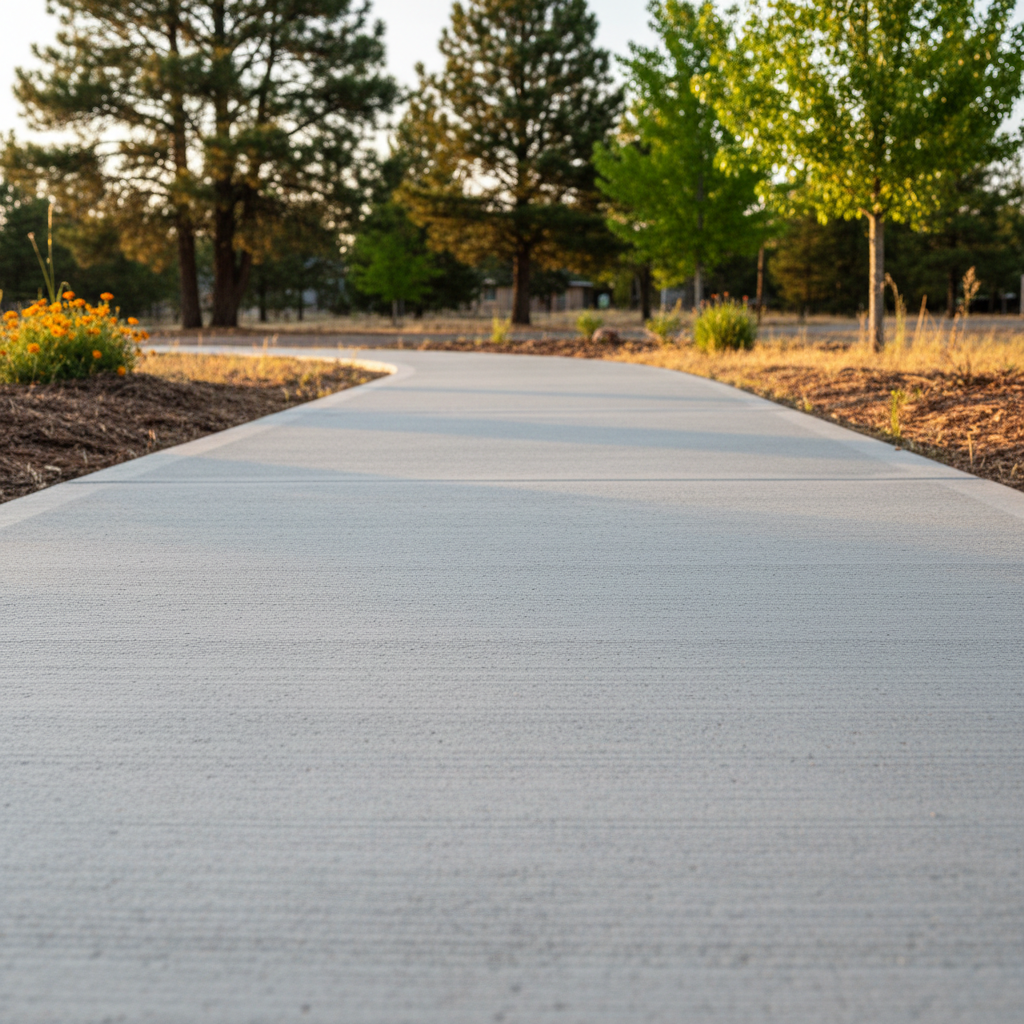
Running a contracting business up here means answering a lot of the same questions every single spring when the snow finally melts off. Homeowners across Flagstaff call us wondering why their old Concrete Sidewalk cracked into pieces or how to plan a new path that will not heave after the first hard freeze. Flagstaff Concrete Paving likes to keep things straightforward for local residents. Here are the real answers to what you are probably wondering about your next Concrete Sidewalk project in Flagstaff, AZ.
Why do concrete sidewalks crack so easily around here?
It mostly comes down to our mountain environment. Flagstaff sits at 7,000 feet, which means we deal with intense freeze-thaw cycles all winter long. Water gets into tiny pores in the concrete or settles in the sub-base, turns to ice, expands, and pushes the slab upward. When things warm up, the ground shifts back, leaving empty spaces underneath. If the mix was not right or the base was not compacted properly, the Concrete Sidewalk cracks under its own weight. Add in our native expansive clay soils that swell when wet and shrink when dry, and you have got a recipe for movement.
How thick should a residential sidewalk actually be?
For standard foot traffic around a house, four inches is the industry standard and works well. That said, if you have a section of the Concrete Sidewalk that crosses a driveway or where heavy snowblowers and equipment run over it, you will want to bump that thickness up to five or six inches and add proper reinforcement like wire mesh or fiber additives in the mix. Skipping thickness to save a few bucks on materials always backfires within a couple of seasons.
Do I need a permit from the city for a new sidewalk?
That depends entirely on where the Concrete Sidewalk sits. If you are pouring a private walkway entirely on your own property in a neighborhood like Foxglenn or Pine Del, you generally do not need a city permit. However, if any part of the concrete touches the public right-of-way, connects to a city street, or crosses an easement, the City of Flagstaff has strict rules about grades, ADA compliance, and property lines. Always check before you pour, because tearing out and re-pouring a Concrete Sidewalk that violates city code is an expensive headache.
When is the right time of year to pour concrete in Flagstaff?
You cannot pour concrete when the ground is frozen or when overnight temperatures drop below freezing before the mix has cured. That leaves us with a window running from late spring through early autumn. Summer monsoons bring sudden afternoon downpours, which require us to keep plastic tarps handy to protect a fresh finish, but warm daytime temperatures give the Concrete Sidewalk the strength it needs. We always monitor overnight lows closely because a sudden September frost can ruin an uncured slab overnight.
Should I choose brushed, stamped, or exposed aggregate?
Standard broom finish is still the most popular choice for a Concrete Sidewalk because it provides a reliable, non-slip surface when it rains or snows. Stamped concrete looks great and mimics flagstone or pavers, but it can get slicker when covered in ice or pine needles if it is not sealed right with a proper grit additive. Exposed aggregate gives you great traction and handles our climate well while adding a bit of natural texture that fits right into our mountain landscape.
How long do I have to wait before walking on new concrete?
You can usually walk carefully on a new Concrete Sidewalk after 24 to 48 hours, depending on how fast it is curing in the current weather. But keep heavy loads, wheeled carts, and pets off it for at least a week. Concrete takes about 28 days to reach its full compressive strength, so treating it gently during that first month makes a big difference in long-term durability.